Qin Mu: The Innocent Raised to Be a Villain
Imagine being raised by nine people. Each one teaches you a skill. One teaches you to lie so convincingly that even you believe it. One teaches you to steal things that cannot be touched — secrets, loyalties, a cultivator's dao heart. One teaches you to kill without hesitation, not out of cruelty but because hesitation is what gets good people killed. You master all of it. You become, by any reasonable definition, a monster. And then, on the day you leave home, all nine of them look at you and say the same thing: "Go. Be good." This is Qin Mu. This is the contradiction at the center of Tales of Herding Gods. And it is, without exaggeration, the most audacious premise for a protagonist I have ever encountered in cultivation fiction.
This analysis is about what happens when a character is built on an impossible contradiction — trained in evil, commanded to do good — and why that contradiction produces something more interesting than a hero or a villain could ever be.
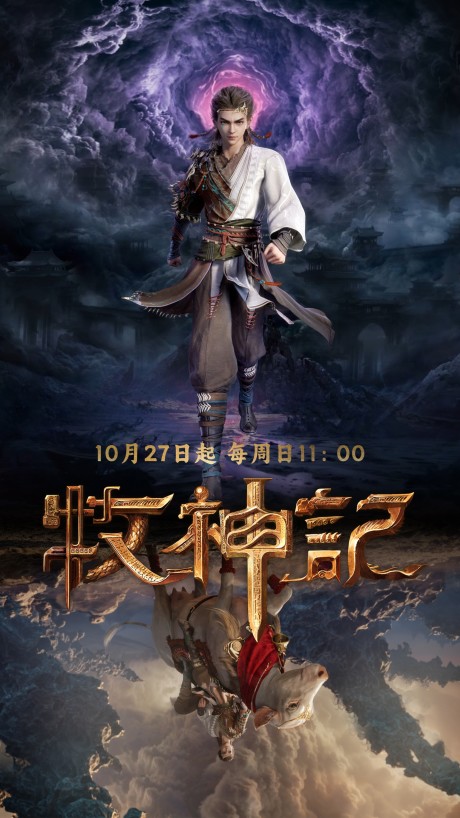
The Village That Raised a Weapon
Qin Mu grows up in Canlao Village, a place so remote that the outside world has forgotten it exists. His nine guardians are crippled elders — each missing limbs, senses, or cultivation bases — who were once among the most powerful figures in the world. They are not kind. They are not gentle. They train Qin Mu the way you train a child for war: relentlessly, without explanation, loading his small body with techniques that would kill most adults. They teach him that the world is cruel and that the only response to cruelty is to become crueler.
And yet. And yet they also love him. Not in the way that love is usually depicted in cultivation fiction — the doting master who secretly protects the disciple from behind. Their love is harsh, practical, and terrifying. They love him by making him hard to kill. They love him by filling his head with every dirty trick they know. They love him by preparing him for a world that will try to destroy him, not by pretending that world does not exist.
This is the first thing that makes Qin Mu different: his childhood is not a tragedy he overcomes. It is a gift he carries. Most cultivation protagonists are orphans or outcasts whose suffering gives them motivation. Qin Mu's upbringing was brutal, but it was not suffering — it was investment. Nine broken masters poured everything they had left into one child, and the child absorbed it all. He does not resent them. He does not rebel against them. He carries them with him, nine voices in his head, each one offering a different kind of terrible advice.
The Skillset of a Villain, The Heart of a Herdsboy
Here is the paradox that defines Qin Mu: he has the skills of a demonic cultivator and the moral instincts of a child who grew up herding cattle. When he enters the wider cultivation world, he does things that shock the orthodox sects — lies to elders, steals techniques from forbidden archives, fights with a brutality that makes witnesses flinch. But he does these things not because he is evil. He does them because his nine elders never taught him that these things were wrong. To Qin Mu, a lie is a tool. A theft is a strategy. Violence is a language. He was never given the moral vocabulary that the cultivation world takes for granted.
And here is where the novel does something extraordinary: it does not punish Qin Mu for this. It does not give him a redemption arc where he learns to be "good" in the conventional sense. Instead, it lets him keep his skills and gradually discover his own moral framework — one that does not match the orthodox world's definitions of right and wrong, but is also not the nihilistic pragmatism his elders practiced. Qin Mu does not become a hero by rejecting what he was taught. He becomes a hero by applying what he was taught to problems the orthodox world cannot solve.
A righteous cultivator cannot infiltrate a demonic sect because they cannot think like a demonic cultivator. Qin Mu can, because his elders were exactly the kind of people demonic sects recruit. A righteous cultivator cannot negotiate with a bandit king because they cannot speak the language of violence. Qin Mu can, because violence was his first language. His darkness is not something he overcomes. It is something he uses, and the novel is clear-eyed about what that costs him.
The Innocence That Survives
The most surprising thing about Qin Mu — the thing that makes him more than an edgy antihero — is that he remains innocent. Not naive. Not stupid. Innocent — in the sense that he genuinely does not understand why the world is so complicated when the solutions seem simple. He looks at a conflict between two sects that has lasted three hundred years and asks: "Why don't you just talk to each other?" He watches cultivators scheme for power and genuinely does not understand what they want the power for. Not because he is above desire, but because his desires are so much simpler than theirs: protect the village, honor the elders, figure out what Da Xu really is.
This innocence is not a flaw the novel corrects. It is the core of his character, and the novel protects it carefully. Qin Mu learns about betrayal, loss, and the true scale of the world's darkness, but he never becomes cynical. His reaction to discovering that the world is much worse than he thought is not despair or bitterness. It is a kind of puzzled determination: if the world is this broken, someone should fix it, and I guess that someone is me.
This is where Qin Mu diverges from every edgy cultivation protagonist who ever lived. Those protagonists learn that the world is dark and decide to become darker. Qin Mu learns that the world is dark and decides to become the light — not because he is pure, but because he has already been trained in darkness and found it insufficient. He knows how to lie, steal, and kill. He also knows, because his elders showed him through their own ruined lives, that these skills will not make you happy. They will keep you alive. They will not give you a reason to live.
The Da Xu Revelation: When the Herdsboy Outgrows the Herd
Qin Mu's central journey is not about gaining power. It is about gaining knowledge. The mystery of Da Xu — the wasteland that surrounds his village, the place everyone told him was empty and dead — is the engine that drives his growth. Every secret he uncovers about Da Xu forces him to reconsider everything he thought he knew. The elders who raised him. The history they taught him. The identity he assumed was his.
This is a different kind of protagonist arc than cultivation fiction usually offers. The typical arc is: I must become stronger to defeat my enemies. Qin Mu's arc is: I must understand the truth, even if the truth destroys everything I believe. Power is a tool for him, not a goal. The Sequence equivalents in Tales of Herding Gods are realms of cultivation that Qin Mu advances through, but the novel never lets you forget that he is advancing them in pursuit of answers, not in pursuit of strength for its own sake.
There is a moment — I will not specify when — where Qin Mu learns something about Da Xu that recontextualizes his entire childhood. He could respond with rage. He could respond with denial. He responds by sitting quietly for a long time, then standing up and continuing. That is Qin Mu in a single gesture: the world breaks his understanding of himself, and he absorbs it, and he keeps going, because the cattle still need herding and the truth still needs finding.
What the Novel Gets Wrong
Qin Mu's arc is brilliant in concept and sometimes uneven in execution. The middle stretches of Tales of Herding Gods — and there are many of them, the novel is over 1,400 chapters — occasionally lose track of his interior life in favor of cultivation mechanics and faction politics. There are arcs where Qin Mu becomes more of a genre protagonist than the specific, contradictory person the early chapters established. He fights. He advances. He acquires new techniques. But the voice in his head — the nine elders, the moral confusion, the herdsboy innocence — goes quiet for long stretches.
This is a structural problem common to long-form web fiction, not a failure of characterization. The novel eventually returns to Qin Mu's core conflict, and the ending honors the premise in ways that are genuinely surprising. But a reader who values psychological realism over plot momentum will feel the absence during those middle arcs. The novel's length is both its greatest asset — it earns the scale of Qin Mu's transformation — and its greatest weakness — it cannot sustain the character work at full intensity for the entire runtime.
Why Qin Mu Matters
Cultivation fiction is full of protagonists who are good at fighting and bad at thinking, or protagonists whose moral complexity amounts to "I kill people but I feel slightly bad about it." Qin Mu is different. He is a protagonist who was built to be a villain and chose to be something else — not a hero in the conventional sense, but a person who uses villainous tools in service of something that looks, from a certain angle, like justice. The novel does not resolve this contradiction. It lets it stand, and it lets Qin Mu live inside it, and by the end you realize that the contradiction is the character.
He is not the strongest cultivation protagonist. He is not the most charismatic. He is the one who feels most like a real person trapped in an impossible situation — because his situation was designed to be impossible, and the novel never pretends otherwise. Nine elders raised a weapon. The weapon decided to become a shepherd. That decision, made over and over across 1,400 chapters, is the story.
📌 Save this analysis — revisit it after you finish the novel and see if you agree with where Qin Mu ends up.
💬 Which elder's teaching do you think shaped Qin Mu most? The liar's silver tongue? The thief's invisible hand? Or the killer's steady heart — the one who taught him that the worst thing you can do in a fight is hesitate?
🔗 Share with someone who thinks cultivation protagonists are all the same.