Why Perfect World Is Peak Xianxia Donghua (And What Makes It Different)
🟡 Moderate Spoilers — This article discusses Shi Hao's character arc, the primordial world setting, and key emotional turning points. No ending details are revealed.
There is a moment early in Perfect World that tells you everything you need to know about what kind of story this is. Shi Hao — a child, barely old enough to hold a weapon properly — is left alone in the wilderness. Not abandoned in a dramatic scene with swelling music and tearful goodbyes. Just… left. The adults who should protect him are gone. The world around him is not hostile in the way a villain is hostile. It is hostile in the way a forest is hostile to a rabbit: indifferent, ancient, and full of things that will eat you without malice. Shi Hao does not cry. He does not despair. He looks at the wilderness that would kill a lesser child, and he starts walking.
That is Perfect World in a single image: a child too young to understand that he should be afraid, walking into a world too old to care whether he survives. And somehow — against every calculation of power, age, and odds — he does.
The World That Feels Older Than You
Most xianxia worlds are elaborate but thin. You get the sect hierarchy, the cultivation ranks, the forbidden zones, the ancient ruins. They are detailed without feeling deep — like a video game map where every location has a purpose and nothing exists just because it does. Perfect World's setting breaks this pattern by building a world that feels genuinely ancient in a way that has nothing to do with lore dumps.
The wilderness in Perfect World is not a place between civilized zones. It is the world. Civilizations are the interruptions. The forests are older than the sects. The beasts remember a time before humans learned to cultivate. When Shi Hao encounters a creature that should not exist — something from an era so distant that even the oldest elders speak of it in myths — the reaction is not "this is a plot device to give the protagonist a power-up." The reaction is genuine, bone-level awe. This world has history that predates its own story, and you can feel the weight of it pressing against the edges of every scene.
This matters because it changes the emotional register of the power progression. In a typical cultivation story, getting stronger means climbing a social ladder — from outer disciple to inner disciple to core disciple to elder. The world is a hierarchy of people. In Perfect World, the hierarchy is ecological. Shi Hao is not climbing through a sect system. He is climbing through a food chain that starts with beasts that can swallow mountains and goes up from there. The stakes are not "will he gain face in front of the elders." The stakes are "will he survive the night."
This is the difference between a world that exists to facilitate a story and a story that exists because the world demanded to be told.
Shi Hao: The Protagonist Who Was Never Civilized
Xiao Yan lost his power and had to regain it. Klein Moretti had to hide his true self behind masks. Wang Lin was broken by tragedy and reforged himself in solitude. These are all compelling arcs, but they share a common starting point: the protagonist was civilized, and then something happened.
Shi Hao was never civilized. He was raised by the wilderness, in the wilderness, on the wilderness's terms. His first moral framework was not "respect your elders" or "follow the sect rules" — it was "survive, protect what is yours, and do not let anyone take what you have earned." This is not a flaw the story corrects. It is the foundation the story builds on. Shi Hao's ferocity is not a phase he grows out of. It is the core of who he is, and the narrative treats it not as something to be tamed but as something to be refined — from raw survival instinct into a principled, fiercely protective strength.
Consider the difference between Shi Hao and the typical "righteous" xianxia protagonist. The righteous protagonist fights evil because it is the right thing to do. Shi Hao fights evil because evil tried to hurt someone he cares about, and he does not let things that hurt his people continue to exist. The outcome is the same, but the emotional logic is completely different — and much more relatable. Most of us do not fight for abstract justice. We fight for specific people. Shi Hao's morality is personal rather than ideological, and that makes his moments of protection hit harder than any speech about righteousness could.
🦴 The bone text is not a power system — it is a mystery. When Shi Hao carves bone texts into his own body, he is not "learning techniques." He is engaging in an act of archaeology on himself — uncovering knowledge that was encoded into the world before the world had words. This is what separates Perfect World's cultivation from every other system in the genre: progression is not about accumulating power. It is about remembering what was lost.
The Loneliness That No Power Can Fix
If Perfect World has a single emotional thesis, it is this: power does not cure loneliness. It makes loneliness more complicated.
Shi Hao spends enormous stretches of the story alone. Not "alone" in the sense of "the side characters are offscreen for a few chapters." Alone in the sense of "there is no one within a hundred miles who speaks his language, shares his history, or understands what he has survived." This isolation is not a temporary hardship. It is the baseline condition of his existence, and the story is honest about what that does to a person.
When Shi Hao does form bonds — with the Willow Deity, with his few true companions, with the family he fights to reunite — those bonds carry enormous weight precisely because of how long he spent without them. A hug between Shi Hao and a family member he has not seen in years is more emotionally impactful than most donghua's entire dramatic arcs, because the story has done the work of making you understand what the absence cost him.
This is the secret weapon of Perfect World's emotional register: it understands that sentiment only works if you have earned it through suffering. The tearful reunion works because you saw the years of solitude that preceded it. The declaration of loyalty works because you saw the betrayals that made loyalty precious. The story does not ask you to care about its relationships. It builds the loneliness first, and then lets the connections feel like sunlight breaking through clouds.
The Visual Language of the Primordial
The donghua adaptation deserves specific praise for its visual treatment of the primordial world. This is not just "good animation" in the technical sense. It is animation that understands what it is depicting. The color palette leans into earth tones and bone whites — not the bright, saturated colors of urban fantasy but the muted, ancient hues of a world that has been weathering for eons. The creature designs are genuinely alien in a way that most donghua monsters are not — these are not "big animals with cultivation levels." They are remnants of evolutionary paths that ended before humans began.
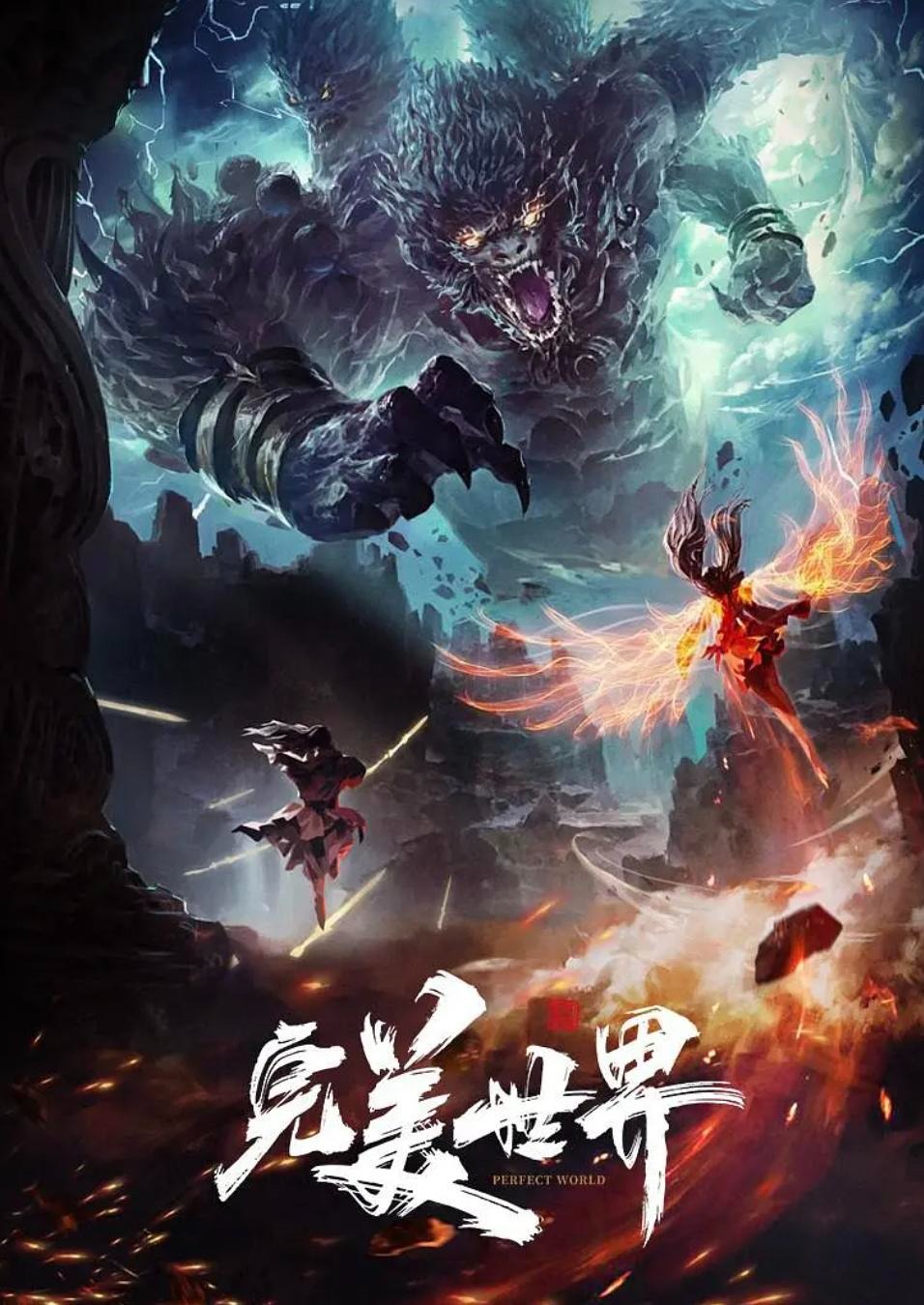
The fight choreography also deserves mention for how it handles scale. When Shi Hao fights something enormous — a mountain-sized beast, an ancient entity, a force of nature given form — the animation does not just make it big. It makes it feel heavy. You feel the impact in your bones. The camera pulls back far enough to show how small Shi Hao is against these forces, and then the fight itself reminds you why size is not the only measure of power.
What Perfect World Achieves That Others Don't
Here is the simplest way to say it: most cultivation donghua want you to be excited. Perfect World wants you to be awed. The difference sounds subtle but is enormous in practice. Excitement is a surface-level emotion — it spikes during fight scenes and fades between them. Awe is deeper. It lingers. It makes you sit quietly for a moment after the episode ends, processing the scale of what you just watched.
Perfect World achieves awe through its worldbuilding — a setting so ancient and vast that the human conflicts within it feel like ripples on an ocean. It achieves awe through its protagonist — a child who should not have survived, who did, and who carries the wildness of his upbringing into every interaction. And it achieves awe through its emotional patience — the willingness to let loneliness sit, to let bonds develop slowly, to let the weight of absence be felt before the relief of reunion arrives.
Is it a perfect series? No. The pacing in transitional arcs can drag. The power scaling in later stages tests the limits of the system's internal logic. Some side characters are introduced with promise and then underutilized. These are real flaws. But they are flaws in a work that is reaching for something bigger than most donghua attempt — and reaching it more often than not. A flawed masterpiece is still a masterpiece. Perfect World is that.