The 22 Pathways of Lord of Mysteries: Why This Is the Best Magic System Ever Written
Most magic systems give you power. Lord of Mysteries gives you power and then tells you, quietly, in the fine print, that every time you use it you are one step closer to losing your mind, your body, and your soul — in that order. There is a moment, late in the first volume, where the protagonist takes a potion that will advance him to the next Sequence, and the narration describes the feeling not as "becoming stronger" but as "something inside him trying to break out." That is the Beyonder pathway system in one sentence. It is not a leveling system. It is a countdown. You are not climbing a ladder. You are walking toward an edge, and the edge is looking back at you.
I have read hundreds of fantasy novels across Chinese, Japanese, and English traditions. I have seen hard magic systems with rules so detailed they ship with appendices. I have seen soft magic systems where the wonder is the point and the rules are none of your business. I have never seen anything like the 22-pathway, 220-Sequence Beyonder system that Cuttlefish That Loves Diving built for Lord of Mysteries. It is simultaneously the most mechanically rigorous magic system in web fiction and the most psychologically terrifying. Every upgrade is a Faustian bargain. Every power has a cost, and the cost compounds. By the time you reach Sequence 0 — godhood — you have paid so much that the question is no longer "what did you gain" but "what is left of the person who started the journey."
This guide will walk through the architecture of the pathway system: the 22 pathways grouped by their source divinities, the 10 Sequences from mortal to god, the madness mechanic that makes every advancement a gamble, and the specific pathways that define the story's most important characters. Whether you are coming from the donghua and want to understand what "Sequence 8 Clown" actually means, or you are a novel reader who wants a structured overview, this is everything you need.
The Architecture: 22 Pathways, 4 Groups, 1 Terrifying Rule
The pathways are not arbitrary. They are grouped into four clusters, each corresponding to a different source of power in the novel's cosmology. Understanding these groups is essential because pathways within the same group are related — and characters who consume potions from adjacent pathways risk spiritual contamination that makes the standard madness risk look like a mild headache.
The Fool Group — pathways of divination, deception, and fate manipulation. The Fool pathway (Sequence 9: Seer) is the protagonist Klein Moretti's starting point. Also includes the Error pathway (theft of fate, time manipulation) and the Door pathway (spatial manipulation, sealing, banishment). These three pathways converge at the top: the Lord of the Mysteries, one of the cosmic entities above even the gods.
The Eternal Darkness Group — pathways of death, sleep, and the boundary between life and death. The Death pathway, the Evernight Goddess pathway (darkness and concealment), and the Twilight Giant pathway (combat and decay). These pathways deal with endings, secrets, and the things that exist in the dark. Azik Eggers, one of the most beloved side characters, belongs to the Death pathway.
The God Almighty Group — pathways of omniscience, creation, and authority. The Visionary pathway (mental manipulation and prophecy), the Sun pathway (purification and light), the Tyrant pathway (storms and ocean authority), and the White Tower pathway (knowledge and omniscience). This group represents the classical "divine" attributes: seeing everything, ruling everything, knowing everything.
The Mother Goddess of Depravity Group — pathways of life, fertility, corruption, and the body. The Moon pathway (vampirism and biology), the Mother pathway (life and fertility), and the Chained pathway (flesh manipulation, restraint, and the monstrous). These are the most viscerally disturbing pathways in the system. The Moon pathway, for example, transforms the Beyonder into something that is no longer entirely human — biologically, metabolically, spiritually.
Above these four groups sit the Outer Gods — cosmic entities from beyond reality whose existence is the source of the pathways themselves. This is not "gods grant powers to mortals." This is "the gods exist, and their existence creates pathways of power that mortals can climb, and climbing them brings mortals closer to the gods, and proximity to gods is not healthy for mortal minds."
The Sequences: 10 Steps From Mortal to God, Each One a Gamble
Each pathway has 10 Sequences, numbered from 9 (lowest) to 0 (godhood). Every advancement requires consuming a potion made from specific Beyonder ingredients — and every potion carries a risk of losing control. The higher the Sequence, the worse the risk.
Sequence 9: The Starting Point. You drink a potion formulated from low-level Beyonder materials, and you gain your first supernatural ability. For the Fool pathway, Sequence 9 is "Seer" — the ability to perform divination, sense danger, and glimpse fragments of fate. It is weak. It is subtle. It is also the moment the countdown starts. Every Seer begins hearing whispers. Quiet ones, at first. The kind you can ignore. The kind you tell yourself are just your imagination.
Sequences 8–6: The Middle Path. These are the "professional" Sequences where a Beyonder develops their core combat and utility abilities. For the Fool pathway: Sequence 8 "Clown" (enhanced physical control and combat intuition), Sequence 7 "Magician" (illusion creation, misdirection, spatial tricks), Sequence 6 "Faceless" (shape-shifting, identity theft). By Sequence 6, a Beyonder is genuinely powerful — and genuinely dangerous to themselves. The whispers are no longer quiet. The potion ingredients are harder to find, more dangerous to handle, and more likely to kill you during the advancement ritual.
Sequences 5–3: The Demigod Threshold. This is where pathways diverge dramatically. Sequence 5 is the last "human" stage. Sequence 4 is called a "Saint" or "Demigod" — a qualitative transformation where the Beyonder begins to manifest their pathway's core domain. For the Fool pathway, Sequence 5 is "Marionettist" (spirit thread manipulation, controlling others like puppets) and Sequence 4 is "Bizarro Sorcerer" (historical projection — summoning temporal copies of past events). At Sequence 3, the Beyonder is more spirit than human. The madness is constant. The fight is no longer about gaining power. It is about not losing yourself.
Sequences 2–0: The Abyss of Godhood. Sequence 2 is an Angel. Sequence 1 is an Archangel — one per pathway at any given time. Sequence 0 is a God — and there can only be one Sequence 0 per pathway. If you want to advance to God, and someone else currently holds the position, you have to kill them. This is not a tournament. This is not a test. This is cosmic-scale murder, and it is the fundamental political logic of the Beyonder world. Every god is a killer. Every god is looking over their shoulder at the Angels and Archangels who want their throne, and every Angel and Archangel is stockpiling Beyonder ingredients and waiting for the moment the god shows weakness.
This is what makes the pathway system so different from conventional leveling systems. In most fantasy, growing stronger makes you safer. In Lord of Mysteries, growing stronger puts a target on your back and a countdown in your soul. The stronger you are, the more the Outer Gods can perceive you. The stronger you are, the more your own pathway's residual will — the echo of every previous Beyonder who held your position — tries to overwrite your identity. You are not becoming more yourself. You are becoming a vessel for something older than yourself, and you are betting that your will is strong enough to stay in the driver's seat.
The Madness Mechanic: Why Every Power-Up Is a Horror Story
The most important thing to understand about the pathway system — the thing that separates it from every other magic system I have encountered — is that the madness is not a side effect. It is not "using too much power makes you tired" or "dark magic corrupts the user." The madness is the point. The pathways are the residual spiritual radiation of dead or imprisoned Outer Gods. When you consume a potion, you are ingesting a piece of a god's corpse. That piece wants to be whole. It wants to reunite with the larger entity it came from. And it will use your body and mind as a bridge to do so.
Every Beyonder hears "whispers" — fragments of the Outer God's residual consciousness. At low Sequences, these are background noise. At middle Sequences, they become intrusive thoughts. At high Sequences, they become a second voice in your head that knows everything you know and wants everything you want, but slightly differently. Slightly wrong. And at the highest Sequences, the question is no longer whether you will lose control but when — and whether anyone is strong enough to stop you when you do.
The Anchor system is the only countermeasure. Beyonders maintain their sanity by anchoring themselves to human experiences: relationships, routines, memories, objects of personal significance. The protagonist, Klein Moretti, anchors himself to his identity as a former Earth human, to his sister Melissa, to the Tarot Club members who know him as "Mr. Fool." These anchors are not sentimental decoration. They are survival tools. Lose your anchors, and you lose yourself. This is why so many powerful Beyonders in the story are isolated, paranoid, and half-mad: they outlived their anchors. Their friends died. Their families died. Their countries fell. And nothing was left to remind them who they used to be.
This mechanic does something brilliant from a storytelling perspective: it makes every character relationship matter. In most fantasy, the protagonist's friends are emotional support. In Lord of Mysteries, the protagonist's friends are literal sanity anchors. Every time Klein spends time with the Tarot Club, every time he checks in on his sister, he is not just being a good person. He is performing essential maintenance on his own mind. This turns every relationship into a double-edged sword — the more people you love, the more stable you are, but the more people you love, the more the Outer Gods can hurt you through them.
The Tarot Club: A Support Group Disguised as a Secret Society
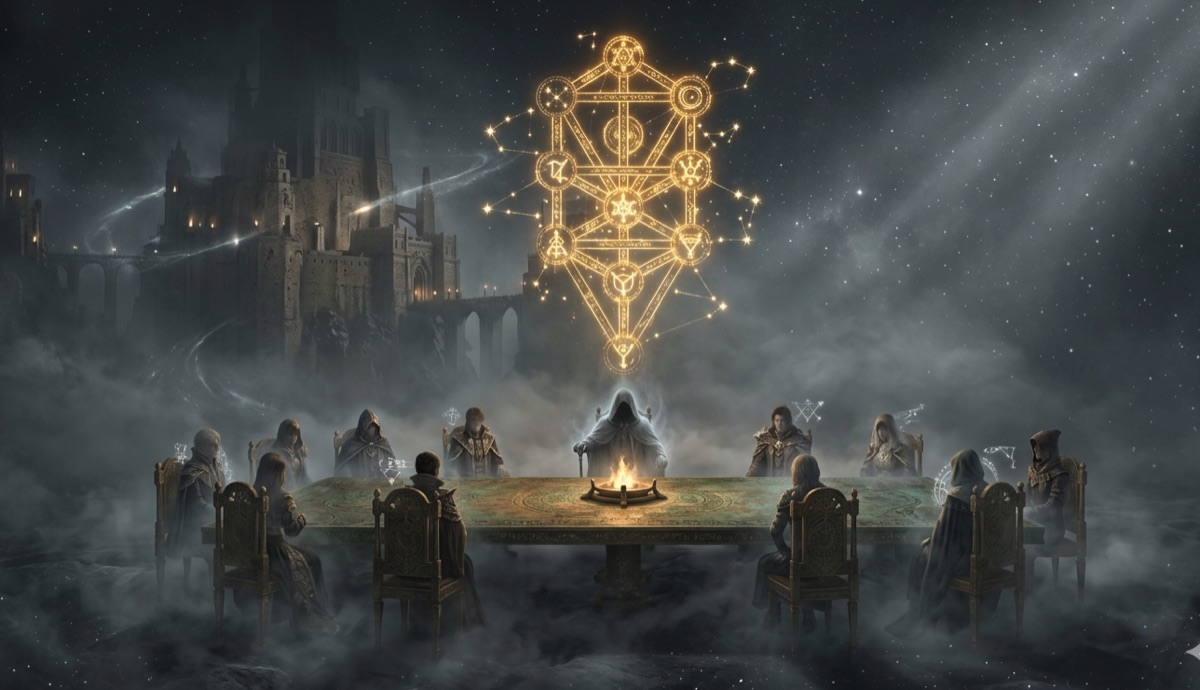
The Tarot Club is Klein's most important anchor, and it deserves attention because it is one of the most structurally elegant narrative devices I have ever seen. Klein, operating under the persona of "Mr. Fool" — a mysterious, ancient, and terrifyingly powerful entity — gathers a group of Beyonders from different pathways. He gives them Tarot card code names (Justice, The Hanged Man, The Sun, The Magician, etc.). He facilitates their meetings in a shared spiritual space above the gray fog. And he carefully, deliberately, never reveals that he is actually a Sequence 9 Seer who has no idea what he is doing.
This is not a joke. This is the core dramatic irony of the entire series. Klein is running a secret society of Beyonders who believe their leader is an ancient god, and he is using their collective knowledge, resources, and trust to survive in a world that would kill him instantly if it knew what he really was. Every Tarot Club meeting is a high-wire act of improvisation. Every question a member asks is a potential existential threat. And every time Klein pulls it off — every time he answers a question with just enough cryptic authority to maintain the illusion — the series reminds you that the protagonist's greatest power is not divination or spirit threads. It is the ability to convince extremely dangerous people that he is more dangerous than they are.
The Tarot Club members represent different pathways, which means Klein has access to the combined knowledge of multiple power systems without having to personally risk the madness of advancing in each one. Justice (Audrey Hall) brings the Visionary pathway's psychological insight. The Hanged Man (Alger Wilson) brings the Tyrant pathway's maritime knowledge and combat ability. The Sun (Derrick Berg) brings knowledge of the dangerous, isolated City of Silver. This is like having a party in an RPG where each member is a different class, except the classes are slowly driving each member insane, and the party leader is secretly the weakest member of the group.
Why This System Matters Beyond Lord of Mysteries
The pathway system has influenced Chinese web fiction in ways that are still unfolding. The idea of "advancement with a cost" — that growing stronger should make the character more vulnerable, not less — has become a hallmark of the darker strain of xuanhuan and xianxia that emerged in Lord of Mysteries' wake. Novels like Deep Sea Embers, Reverend Insanity, and My House of Horrors all show traces of the pathway logic: power is not a reward, it is a transaction, and the bill always comes due.
For the donghua adaptation, the pathway system presents both a challenge and an opportunity. The challenge is exposition: how do you explain 22 pathways, 220 Sequences, and the madness mechanic to an audience that has never read the novel, without turning the first three episodes into a lecture? The opportunity is visual: the sequence advancements are some of the most cinematic moments in the source material. When Klein advances to Faceless, the description of his body literally reshaping itself — bones cracking, skin flowing like liquid, features rearranging into someone else's face — is body horror of the highest order. If the donghua commits to animating these transformations with the intensity they deserve, it will have some of the most memorable power-up scenes in animation history.
Bottom line: The 22-pathway Beyonder system is not the best magic system in fiction because it is the most complicated. It is the best because it is the most meaningful. Every power is a choice, every choice has consequences, and the consequences are never just "you get tired." They are "you might lose yourself." That stakes everything — every fight, every advancement, every relationship — in a way that makes Lord of Mysteries feel less like a power fantasy and more like a survival horror story where the monster is the one growing inside you.
📌 Save this guide — it will make sense of every Sequence advancement in the donghua.
💬 Which pathway would you choose, knowing the cost? The Fool's divination and deception, or the Visionary's mental authority — and how long do you think you could hold onto yourself?