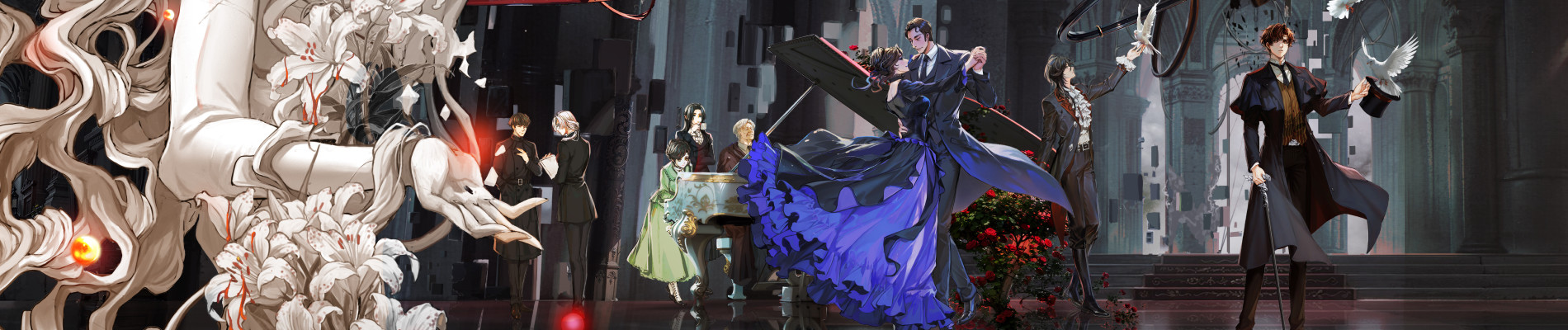
The World Is Victorian London, But Cthulhu Lives Down the Block
Forget everything you know about Chinese cultivation novels. Lord of Mysteries doesn't take place in ancient China. It doesn't take place in a fantasy kingdom. It takes place in a world that looks like 1890s London.
Steam trains. Gas lamps. Top hats. Stock exchanges. Detective agencies. Newspapers. Police constables. The author Cuttlefish That Loves Diving built an alternate Victorian world called the Loen Continent, dominated by three industrial empires:
- The Loen Empire — basically Victorian Britain. The protagonist starts here.
- The Intis Republic — basically post-Revolution France.
- The Feysac Empire — basically Tsarist Russia.
Ordinary people live ordinary lives. They worry about rent. They work in factories. They read the morning paper.
But underneath the gaslit surface is a hidden world of secret churches, ancient curses, monstrous cults, mutated nightmares, and gods who never quite died. And here's the part that makes this novel different from every other supernatural story you've read:
In Lord of Mysteries, power costs your mind. Every transcendent being — every wizard, every priest, every monster hunter — is one bad day away from becoming a monster themselves. Supernatural ability comes packaged with spiritual pollution, personality erosion, and the slow drift toward madness. That's not flavor text. That's the engine of the entire story.
If you ever wondered why the protagonist seems so cautious, so paranoid, so unwilling to just use his powers — this is why. Using power means losing yourself. The whole novel is about how to climb the ladder of supernatural strength without falling off the edge of your own sanity.
The Sequence System: The Numbers That Confuse Everyone
Here's the rule that breaks most new readers: lower number = stronger.
Everyone in the supernatural world is ranked on a ladder from Sequence 9 (weakest newbie) up to Sequence 0 (literal god). Climbing the ladder means going down in numbers. A Sequence 4 is way stronger than a Sequence 8. A Sequence 1 is unimaginably stronger than a Sequence 4.
The full ladder looks like this:
| Stage | Sequences | What They Are |
|---|---|---|
| Low-Sequence | 9 → 8 → 7 | Newbies. Strong enough to beat gangsters and minor monsters. Most field agents stay here. |
| Mid-Sequence | 6 → 5 | Elite. Specialized abilities, dangerous in a fight. Church captains and senior agents. |
| Demigod | 4 | The first real qualitative leap. Can suppress entire supernatural disasters alone. Near-immortal lifespan. |
| Angel | 3 → 2 → 1 | Reality-bending. Can bend regional rules, travel across continents instantly, exist in multiple places at once. |
| True God | 0 | Supreme. Each one rules a fundamental principle of the universe. Only a handful exist in the current era. |
Here's the critical part the novel doesn't always spell out: each Sequence isn't just "more powerful" — it's a different kind of being. A Sequence 6 isn't just a buffed-up Sequence 7. They have different abilities, different personality drift, different vulnerabilities, different ways of seeing the world. Climbing the ladder doesn't make you a stronger version of yourself. It changes what you fundamentally are.
This is why characters who've been Sequence 4 for decades often act and think differently than mortals. They've stopped being human in any meaningful sense.
The Acting Method: The Soul of the Entire Novel
Forget everything you know about how characters get stronger in fantasy. In most novels, the protagonist trains, meditates, or absorbs energy. They put in the work, they level up. Simple.
In Lord of Mysteries, you drink a potion.
That's the easy part. That's 30% of the promotion. The other 70% is so weird that most readers don't understand it until volume 2 — so let me explain it now, in plain English.
Every Sequence has a name. Sequence 8 is the Clown. Sequence 6 is the Faceless. Sequence 5 is the Marionettist. Each one is built around an archetype — a way of being. A personality. A worldview.
When you drink the potion for that Sequence, the potion doesn't just give you powers. It gives you the archetype itself. It tries to write itself into your mind. The Clown potion wants you to become a Clown — cynical, mocking, indifferent to suffering. The Marionettist potion wants you to become someone who sees other people as puppets to be moved.
And here's the catch: if you don't digest the potion, the potion digests you.
What "Acting Method" actually means: To survive the potion, you have to act out the role. You have to be the Clown. You have to think mocking thoughts. You have to live the archetype until your soul absorbs the rule, integrates it, and stops being threatened by it. Acting isn't pretending. Acting is the only way to coexist with the power without going mad.
This is why the protagonist seems obsessed with playing characters. It's not a quirk. It's survival. Every time he advances, he has to live as someone new for months until the potion is "digested." Skip the acting, fail to commit, and you become a Beyonder who's lost themselves — which is exactly how the villains in this novel get made.
Once you understand this, everything Klein does makes sense. The disguises aren't aesthetic choices. They're how he stays alive.
Klein's Four Identities (Yes, He's All of Them)
One of the biggest sources of confusion for new readers: the protagonist keeps showing up under different names, in different cities, doing different jobs. Are these the same person? Are they different chapters? Is the novel jumping timelines?
They're all him. Welcome to the protagonist's four public faces.
| Identity | Volume | Where | What He's Doing |
|---|---|---|---|
| Klein Moretti | Volume 1 | Tingen City | Low-level government employee. Night Watchman trainee. Investigates paranormal incidents. The "original" identity. |
| Sherlock Moriarty | Volume 2 | Backlund (capital) | Private detective. Solves cases, gathers intelligence, makes money. Middle-class life with double identity. |
| Gehrman Sparrow | Volume 3 | The Five Seas | Mad bounty hunter. Famously kills pirates and demigods. The combat identity. Feared across the world. |
| Dawn Tanze | Volume 4+ | Backlund nobility | Wealthy aristocrat. Moves in royal circles. Long-game political maneuvering and revenge. |
But here's the part that matters most — the part most casual readers miss:
Each identity is a different Sequence. Klein Moretti, Sherlock, Gehrman, and Dawn aren't just costumes. They're how the protagonist does his Acting Method. Each identity corresponds to a pathway, a personality, a way of being. He switches names because he needs to switch souls. The detective in Backlund is digesting one Sequence; the sea hunter is digesting another. Same person. Different archetypes running at the same time.
And underneath all of those? A fifth identity. The hidden one. The Fool — a name above a gray fog that sits outside the world itself. The founder of the Tarot Club. The thing the gods can't see.
That's the protagonist's real face. The other four are masks he wears so the world never figures out who's behind them.
The Gray Fog: Klein's Secret Weapon (No, It's Not Magic)
Early in the novel, Klein discovers he can enter a space full of gray fog with a long table inside it. He calls this place Sefirah Castle, also just called the Gray Fog. New readers usually think this is some dream sequence, or a mental visualization. It's not. It's real.
Here's what the Gray Fog actually does, without spoiling its origin:
1. Invisible to Gods
Nothing inside the Gray Fog can be detected by any entity in the regular world — not deities, not angels, not the most powerful divination magic in existence. It's the only truly private room in the universe.
2. Resurrection
In extreme situations, the Gray Fog can pull Klein back from the brink of death and rebuild his body. This is his ultimate insurance policy throughout the early arcs.
3. Potion Formulas
The Gray Fog can deduce the correct ingredients for any Sequence potion. In a world where bad formulas drive people mad, this is worth more than gold.
4. The Tarot Club Meeting Room
The Gray Fog is where Klein hosts his secret organization. Members appear at the long table from wherever they are in the world. Real-time, instant, undetectable.
Everything Klein does — every layout, every clever play, every information advantage he has over enemies stronger than him — flows from the Gray Fog. It's the asymmetric edge that lets a low-Sequence character outmaneuver Sequence 4s and Sequence 3s. When you understand the Gray Fog, you understand why this story isn't just another underdog fantasy. The protagonist has a structural advantage nobody else can match.
The Tarot Club: What's Actually Happening in Those Meetings
Klein recruits people. He doesn't tell them his real name, and they don't tell him theirs. Each member takes a Tarot-card codename. They meet in the Gray Fog. They trade information, resources, potion ingredients, and intelligence about the secret world.
Here's why this matters: every member is in a different part of the world. Klein has no way to be everywhere at once. The Tarot Club is his way of being everywhere at once through other people. It's the most elegant information network in modern fantasy fiction.
The core early members you need to remember:
Audrey Hall
A Loen Empire noblewoman in the Psychological Alchemy Pathway. Provides Klein with intelligence from high-society aristocratic circles — the kind of information a Tingen civil servant could never access.
Alger Wilson
A senior sailor in the Storm Church, traveling the Five Seas year-round. Brings maritime intelligence, pirate movements, and oceanic supernatural knowledge to the table.
Derrick Berg
A teenage survivor in the abandoned Silver City. Lives in a world of perpetual darkness, surrounded by lost ancient knowledge. The pipeline for archaic supernatural lore.
The Fool (Klein)
The founder. Sits above the Gray Fog. Coordinates information flow, mediates trades, and protects the club from external detection. Nobody knows who he actually is.
Once you understand the Tarot Club as an asymmetric information network — not a friendship club, not a fantasy guild — every chapter that involves a meeting becomes immediately readable. Klein isn't hanging out with friends. He's running an intelligence agency from a hidden dimension. And his "intelligence agents" don't even know they work for him.
The Three Major Churches (Don't Confuse These)
The supernatural world is governed by three major orthodox churches, each tied to one of the dominant pathways and one of the major empires. New readers mix them up constantly because the novel doesn't always pause to remind you which one is which.
Church of the Night
Pathway: Night. Focus: spirituality, dreams, shadows, death. Operates the Night Watchers — the official supernatural police force Klein joins in Volume 1. Most early-game lore comes from this church.
Church of Steam & Machinery
Pathway: Steam. Focus: industrial enhancement, mechanical modification, physical augmentation. The most "industrial revolution" of the three. Dominates technological development across the empires.
Church of the Storm
Pathway: Storm. Focus: oceans, thunder, wind, raw destruction. Rules the Five Seas and all major naval forces. The most aggressive and outwardly powerful of the orthodox churches.
And surrounding the three orthodox churches: dozens of heretical sects, secret societies, and outright criminal organizations — most of which are running Sequences from corrupted or forbidden pathways. Every paranormal case in the early novel involves a faction from this underground world.
Why You'll Stay Hooked Past Chapter 100
Now that you understand the rules, here's what makes this novel one of the most recommended works in modern Chinese fiction. Four core pleasures that pay off across every single volume:
- High-IQ strategic wins. The protagonist almost never wins by being stronger. He wins by being smarter. Identity layering, information asymmetry, deliberate misdirection, and patient long-game planning. Every victory feels earned.
- Identity contrast. Klein lives four lives simultaneously and a fifth one in secret. The dramatic irony of watching him be a quiet detective by day and a feared sea hunter by night is genuinely addictive.
- Real slow-burn progression. No power scaling shortcuts. No convenient breakthroughs. Every Sequence advancement takes real preparation, real time, and real costs. When the protagonist does finally promote, it feels enormous.
- Foreshadowing that actually pays off. Cuttlefish doesn't write random twists. Every "weird detail" in volume 1 turns out to matter in volume 5 or 7. Re-reading the novel reveals dozens of hidden setups you didn't notice the first time. This is genuinely rare in any genre, let alone web fiction.
Where to Watch & Read Lord of Mysteries
All recommendations below are official, licensed channels. We don't link to pirated content — the author and studio deserve support.
Watch the Donghua
Official international streaming. The donghua adaptation by B.CMAY PICTURES with simulcast English subtitles. This is the recommended way to watch.
Watch on Crunchyroll →Affiliate link — small commission may apply, no extra cost to you.
Bilibili's official overseas channels host many donghua episodes for free with English subtitles. Selection varies by region and licensing.
Browse Muse Asia →Read the Original Novel
The original web novel by Cuttlefish That Loves Diving, translated officially into English. The donghua adapts maybe 20% of the source material — the novel goes deeper, longer, and reveals far more. Strongly recommended if you want the complete experience.
Why read the novel? The donghua can only show what fits in a season. The novel runs nearly 1,400 chapters and includes massive plot lines, character arcs, and world-building that the animation will probably never reach.
Read on Webnovel →Affiliate link — small commission may apply.
What This Guide Cannot Cover
Lord of Mysteries is vast. This guide covers the first 100 chapters — enough to get you through the confusion that makes most new readers quit. The Tarot Club's later members, deeper Sequence pathway interactions, and the geopolitical landscape beyond the three major churches deserve their own guides. For now, this is your survival kit.
You're Ready
That's it. That's the whole entry barrier. Once you understand:
- Sequences (lower = stronger, each one changes what you fundamentally are)
- The Acting Method (you live the archetype or it eats you)
- The Gray Fog (Klein's invisible private dimension)
- The four public identities (and the hidden Fool above them all)
- The Tarot Club (a global intelligence network in a fog room)
- The three churches (Night, Steam, Storm)
...you can read the rest of the novel without getting lost. Every twist will land. Every "wait, what just happened?" moment will resolve into "oh, that's brilliant."
The first 100 chapters are the gate. You just walked through it. The rest of the novel is the reward.
See you on the other side. — Aion