Link Click: The Donghua That Will Break You (And Why That's Good)
Two men. A photo studio. And the ability to enter photographs and change the past. The best time-travel story since Steins;Gate — and it's Chinese.
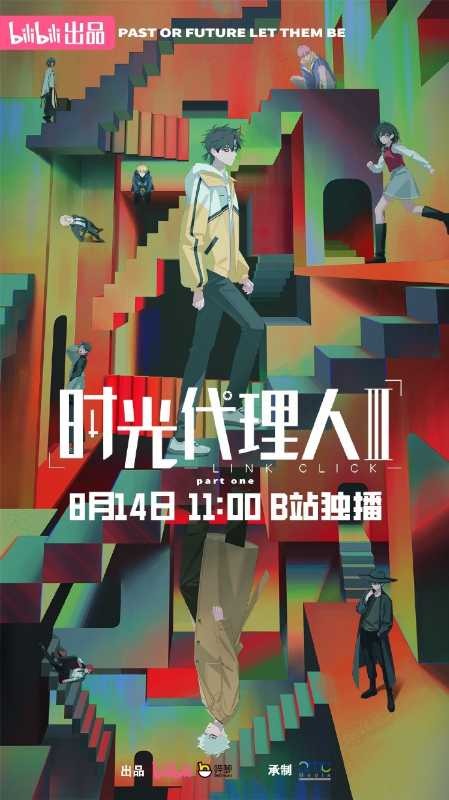
I watched episode 5 of Link Click at 2 AM on a Tuesday, thinking I'd watch one more and go to sleep. An hour later I was still sitting in the dark, staring at the credits, feeling like someone had reached into my chest and rearranged something. I've been watching anime for fifteen years. I've seen Clannad. I've seen Your Lie in April. I thought I knew what an animated show could do to me. Link Click humbled me in 23 minutes flat.
This is not hyperbole. This is not me trying to sell you on a show. This is me telling you, as someone who has watched hundreds of anime and dozens of donghua, that Link Click does something with the time-travel genre that I have never seen before — and I need you to understand why before you dismiss it as "just another Chinese cartoon."
If you hate time-travel stories because they're convoluted or full of paradoxes, this article is for you. If you've never watched a donghua and you're not sure where to start, this article is for you. If you've already watched Link Click and you just want to read someone else process what happened, this article is also for you.
🟢 Spoiler level: None. This guide discusses the premise, structure, and emotional DNA of the show. No major plot twists, no episode 5 details, no ending reveals.
The Core Thesis: Why Link Click Works When Most Time-Travel Shows Don't
Most time-travel stories are about the mechanics. They want you to marvel at the cleverness of the timeline. Steins;Gate spends hours explaining worldlines and divergence meters. Tenet wants you to diagram the inverted entropy. These are good stories. But they treat time travel as a puzzle, and the audience's job is to solve it.
Link Click does something fundamentally different. It treats time travel as a relationship mechanic. Cheng Xiaoshi doesn't dive into photos to fix timelines. He dives into photos to understand people — their regrets, their secrets, the things they couldn't say before it was too late. The time travel is not the point. The point is what people do with the time they have, and what they wish they'd done differently.
This is why the show can make you cry in an episode where nobody dies. It's not tragedy that breaks you. It's recognition. You see a character make a choice you've made. You see a conversation you've avoided. You see a farewell you never got to give. And the show holds the camera on that feeling until you feel it too.
The Setup: A Photo Studio Where the Past Is Never Really Past
Cheng Xiaoshi and Lu Guang run a small photo studio called Time Photo Studio. It looks unremarkable from the outside — just two young men running a quiet business in a nondescript Chinese city. But they have a secret: Cheng Xiaoshi can enter photographs and relive the moments they captured. Lu Guang, who possesses the ability to see the past and future of any photo within 12 hours of it being taken, guides him from the present.
The rules are simple: Cheng Xiaoshi inhabits the body of the person who took the photo. He can move, speak, and interact within the 12-hour window of the photograph. He can change events — but he shouldn't. Every change ripples forward. A small kindness can save a life. A small mistake can end one.
Their clients come to them with requests — find a missing person, uncover a secret, deliver a message to someone who's gone. Each episode is a self-contained mission, but these missions build toward something larger. By the end of season 1, the procedural structure reveals itself as a carefully constructed fuse, and the last three episodes light it.
很多人只看到 Link Click 每集独立的案件结构,就以为是单元剧。但他们错过了关键的东西——前面每一集的细节都在为最后三集铺路。When the finale hits, you realize the show was never episodic. It was a single continuous story, told through windows into other people's lives.
The Emotional Engine: Why Episode 5 Changed Everything
I won't tell you what happens in episode 5. Partly because I promised no spoilers. Mostly because describing it would rob you of the experience. What I can tell you is this: episode 5 is the moment most viewers realize they are watching something extraordinary.
Before episode 5, Link Click is a very good procedural with a clever premise. After episode 5, it is a show that has demonstrated it can reach into your chest and squeeze. The shift is not in plot — the plot was always heading there. The shift is in emotional ambition. Episode 5 says, quietly and without fanfare: we are not messing around. We are going to make you feel things, and we are going to earn every single one.
This is not a show that manipulates you with cheap tragedy. It earns your tears through careful, patient setup — establishing characters you care about, showing you their ordinary lives, and then revealing, piece by piece, the weight they've been carrying the whole time.
The Design: Why Link Click Looks and Sounds Different
Studio LAN's visual approach is striking in its restraint. The color palette shifts between the present — muted blues and grays, a world slightly drained of warmth — and the past, which is bathed in golden-hour light, every frame looking like a photograph you'd find in a shoebox and hold onto for years. The contrast is not subtle once you notice it, but the show never calls attention to it. It trusts you to feel the difference.
The character designs by INPLICK (the Korean artist whose original character sheets went viral before the show even aired) are deceptively simple — clean lines, expressive eyes, hair that moves like hair and not like plastic. Cheng Xiaoshi in particular has a face built for emotional devastation: wide-eyed, earnest, the kind of face that makes you want to protect him from whatever the show is about to do to him.
The soundtrack, composed by a team led by Kajiura Yuki collaborator Takada Ryuichi, is understated until it isn't. The opening theme — "Dive Back in Time" by Bai Sha JAWS — is an earworm that gains new meaning with every episode. The closing theme, played over credits that you will sit through because you need the time to recover, is a song called "OverThink" that the show's English-speaking fans have analyzed to death for hidden lyrical clues. They're probably right about some of them.
The Characters: Cheng Xiaoshi, Lu Guang, and the Weight They Carry
Cheng Xiaoshi is not a typical protagonist. He is impulsive, emotional, and constitutionally incapable of following rules when someone is suffering in front of him. His power — entering photographs — puts him directly inside other people's pain, and he cannot turn away from it. This is both his greatest strength and the source of every mistake he makes. You will want to shake him. You will also understand exactly why he does what he does.
Lu Guang is his opposite: calm, analytical, capable of seeing consequences that Cheng Xiaoshi cannot. Where Cheng Xiaoshi acts on instinct, Lu Guang calculates. But Lu Guang is not cold — he carries a burden the show only hints at in season 1, and his protectiveness toward Cheng Xiaoshi is not just professional. There is something he knows that Cheng Xiaoshi doesn't. The show is patient with this thread. It does not rush the reveal. It lets the weight accumulate.
Their partnership is the core of the show, and it works because the show does not romanticize it. They argue. They disagree on fundamental principles. Cheng Xiaoshi's empathy leads them into danger. Lu Guang's caution sometimes feels like coldness. But they trust each other absolutely, and the show makes you believe in that trust without ever having to state it out loud.
The Objective Flaws: What Link Click Gets Wrong
No show is perfect, and Link Click has its share of rough edges. The first two episodes spend a lot of time on setup — necessary setup, but the pacing feels slower than the show will become, and some viewers drop off before the show reveals what it's capable of. Season 2, while excellent, can feel compressed — 12 episodes to resolve threads that season 1 spent 11 episodes building, and the compression is felt in certain character beats that deserved more room to breathe.
There is also the question of accessibility. Link Click is a show that rewards attention — miss a background detail in episode 3 and you'll miss a payoff in episode 9. This is a feature, not a bug, for attentive viewers. But if you're the kind of person who watches shows while scrolling your phone, you will miss things that matter. The show does not accommodate passive viewing.
How It Compares: Steins;Gate, Your Name, and the Time-Travel Canon
Comparisons to Steins;Gate are inevitable and mostly fair. Both shows use time travel to explore human connection rather than sci-fi spectacle. Both pivot from lighthearted early episodes to devastating later ones. Both feature protagonists who are fundamentally decent people making impossible choices.
But Link Click is not Steins;Gate with Chinese characters. The emotional register is different. Steins;Gate is about sacrifice on a cosmic scale — saving the world by giving up the person you love. Link Click is about sacrifice on a human scale — the small, daily choices that determine whether someone lives or dies, and whether you can live with the outcome. The philosophical question is not "can you change fate" but "should you, when the price falls on someone else."
If Steins;Gate is a novel, Link Click is a collection of short stories that turn out to be chapters in a novel you didn't know you were reading. Both are masterpieces. They are masterpieces of different things.
Where to Watch & Viewing Order
Season 1: Episodes 1-11, plus the special episode 5.5 (recommended between episodes 6 and 7 — it's a prequel that adds critical context for a season 2 character reveal).
Season 2: Episodes 1-12. Picks up exactly where season 1 ends — no time skip, no recap, no mercy.
Season 3: Confirmed, teaser released, expected late 2026 or early 2027.
Legal streaming platforms:
- Crunchyroll — Both seasons, English subtitles. Best option for Western viewers.
- Funimation — English dub in select regions.
- Bilibili Global — Official Chinese release with English subtitles.
We only link official, licensed platforms. Supporting these channels directly funds future seasons.
The Bottom Line
Link Click is 23 episodes. That is shorter than one season of My Hero Academia. In that time, it will make you laugh, make your pulse race, and make you cry at least twice — possibly three times if you are the kind of person who cries at animated noodle recipes (you will understand after episode 2).
It is the best entry point for Western anime fans into Chinese animation. It requires zero cultivation knowledge, zero familiarity with Chinese mythology, and zero tolerance for the genre conventions that sometimes make donghua feel inaccessible. All it requires is that you care about people — and that you're willing to let a show remind you why you do.
Watch episode 1 tonight. If you make it to episode 5, you'll understand why this guide exists. If you make it to the end of season 1, you'll understand why I couldn't write it any other way.
📌 Save this guide — you'll want to come back after episode 5. Trust me.
💬 What time-travel story broke you the hardest? Steins;Gate? Your Name? Or something nobody's heard of? Tell me in the comments — I'm always looking for the next one that'll wreck me.
🔗 Know someone who refuses to watch donghua? Send them this. Link Click is the one that changes minds.